
Design Inspiration
July 21, 202415 min
Interior Design Movements 2026: Minimalism, Japandi and 8 Other Styles
From Classic to Minimalism, Art Deco to Japandi, a comprehensive guide to the most influential interior design movements worldwide.
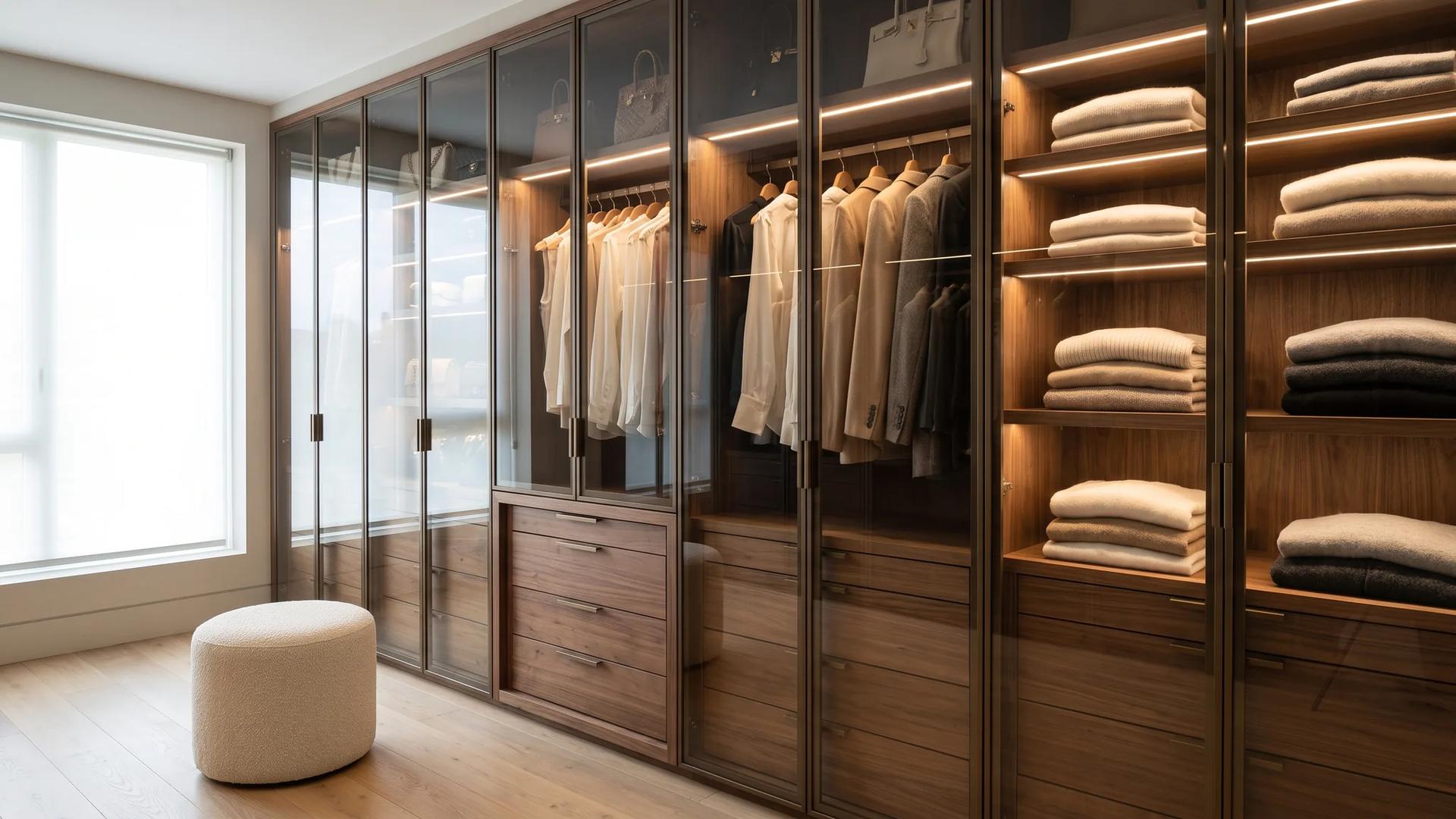
A glass-door dressing room becomes the most photographed corner of a bedroom. Still, I ask every client the same question first: is the inside of your wardrobe tidy every day? A glass door is a display case. It shows order and clutter with the same honesty. If the answer is "not usually", we do not glaze the whole wall, only the sections worth showing.
A glass-door dressing room is a dressing area where all or some of the cabinet doors are clear or tinted glass. With the door closed, the contents stay visible but protected from dust. It sits between open shelving and a closed wardrobe: not as reachable as an open shelf, not as concealing as a closed cabinet. That is why the best results come from a semi-open plan that mixes glass sections with open shelves and closed storage.
Handbags, shoes, watches and glasses, jackets and carefully hung shirts look good behind glass. They deserve to be seen and they suffer most from dust. Folded everyday clothes, underwear, sportswear and seasonal piles belong in closed sections. The ratio we use in practice is roughly a third of the wall in glass, the rest closed or drawers.
There is also the sun. A glass wall facing a window can fade fabric colors over the years. If your dressing room gets direct daylight, we put the glass sections on a wall perpendicular to the window, or suggest a sheer curtain where the light falls on the glass.
Door glass must be tempered. Tempered glass is far more resistant to impact than ordinary glass, and if it breaks it crumbles into small blunt pieces instead of sharp shards. In homes with children this is a requirement, not a preference.
The tint changes the mood of the room. Clear glass shows the contents as they are, including any disorder. Smoked or bronze-tinted glass softens the view, hides a little clutter, and pairs well with dark wood and brass details. Frosted glass behaves almost like a closed door and leaves only silhouettes. We always choose the tint on a real sample in the light of the room; a small square in a catalog is misleading.
A slim metal profile looks contemporary and light and puts the glass forward. A wood frame is warmer and keeps the dressing room in the same material language as the rest of the bedroom. In our glass-door wardrobes we mostly use solid wood frames, because the door does not warp over time, hinge screws hold for years, and a frame in the same tone reads as one piece with the carcass. We explain why carcass material matters so much in our solid wood or laminate guide.
The real job of a glass door is to keep dust out. Without a thin seal between the door and the carcass, the glass only does half the job; after a few months you see a fine layer of dust at the back of the shelves. Sections that are rarely opened must have a seal.
A hinged door opens fully and closes best against a seal, but it needs 50 to 60 centimeters of swing space in front. In a narrow dressing room a sliding glass door can make more sense. Because two sliding panels overlap, dust protection is slightly weaker; we balance that by reducing the number of doors and using a high-quality track.
What turns a glass section into a display is the light inside it. A slim strip hidden under the front edge of each shelf is planned to switch on when the door opens or with motion. Choosing a neutral white that shows color correctly matters; under very warm light navy blurs into black and grey into beige. This light is built as part of the cabinet. Ceiling and room lighting belong to your electrical plan, which we coordinate with your electrician or interior architect.
A dimension mistake in a glass section is immediately visible, because everything is on show. The basic measurements we work with:
We drew corridor widths, islands and layouts by area for 4, 6 and 8 square meters in our walk-in closet planning guide.
Glass doors hold fingerprints. Putting the handle on the frame rather than the glass solves most of this. An alcohol-free glass cleaner and a microfiber cloth are enough for cleaning; keep liquid off the wood frame. Wiping the seals once a year with a soft damp cloth keeps the close firm for a long time.
If you collect handbags, shoes or watches, if you like order, and if the dressing room is visible from the bedroom, glass doors are the right choice. If your mornings are rushed, if clothes land on the shelf instead of being folded, or if the room gets a lot of sun, keep the glass small. Here the right answer is often "a little glass".
You can see our glass-door wardrobe and dressing room work on the glass-door wardrobe page and in the wardrobes category. Send us your room dimensions and a photo, and we will draw together which wall should be glass; production for a single room takes about six weeks. You can start from our quote page.
From Classic to Minimalism, Art Deco to Japandi, a comprehensive guide to the most influential interior design movements worldwide.
What changed in 2026 furniture trends? Warm minimalism, Japandi, organic forms and the natural materials revolution, expert analysis.
Browse our crafted furniture collection, each piece designed with the same principles discussed in this article.
Design inspiration, new collections and expert guides, directly to your inbox.
Our team of expert designers and craftsmen are ready to bring your vision to life.
Get a quote for your project
Get Quote