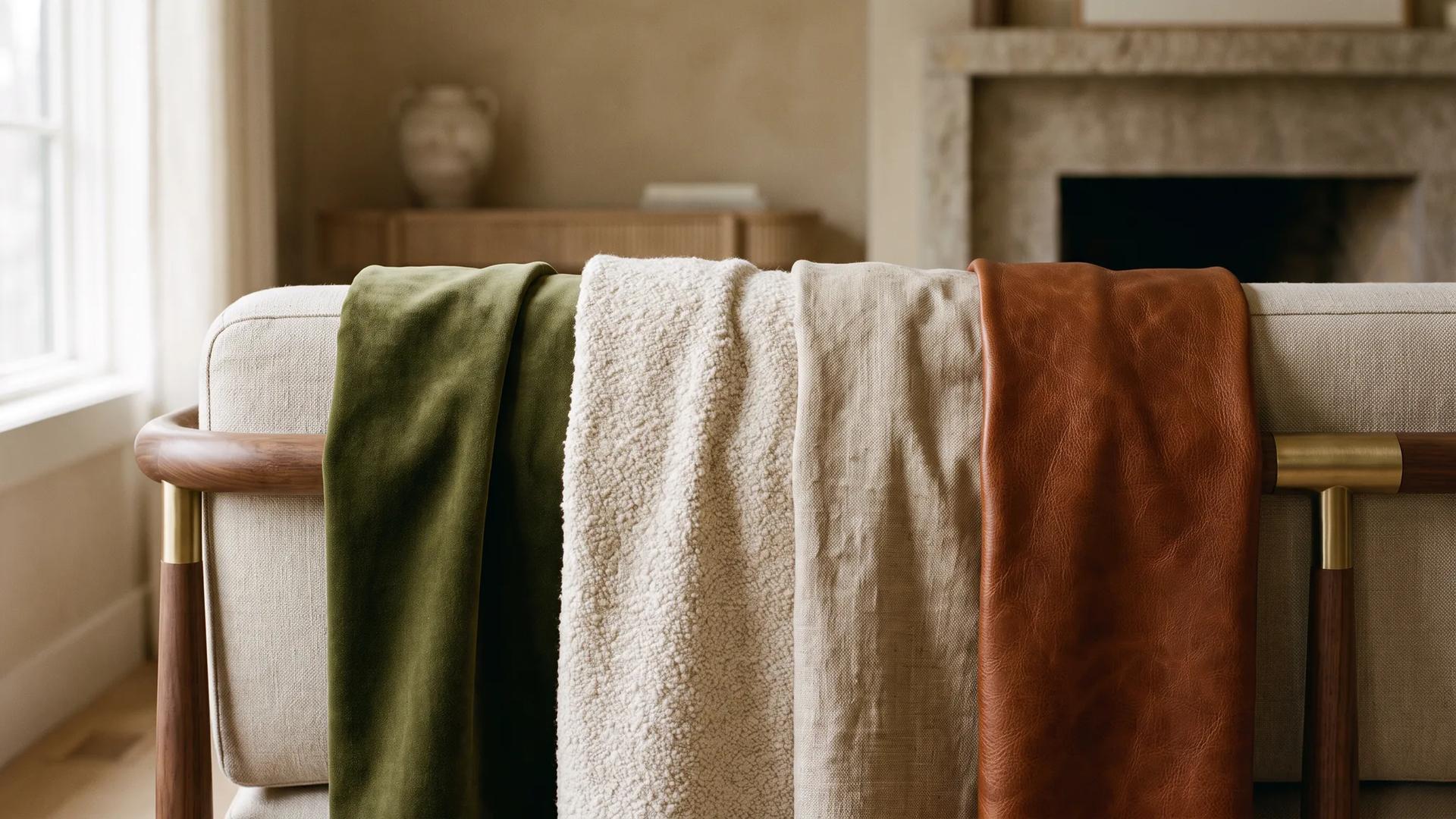
What is the single most critical element that determines how a chair will make you feel? Its design, legs, form, all of these matter, of course. But the first thing your fingertips touch, the first thing your eyes notice: the fabric.
Upholstery fabric directly shapes both the visual and physical experience of a piece of furniture. The wrong choice will wear out even a perfect frame within three years. The right choice retains its value, aesthetically and structurally, for years to come.
Velvet, bouclé, linen, or leather? We compare four main upholstery categories, their strengths and weaknesses, which spaces and lifestyles each suits best, and what maintenance really looks like.
1. Velvet: The Timeless Allure of a Classic
What Is It?
Velvet is a woven fabric with a short, dense pile that gives it its characteristic smoothness and light-shifting appearance. Historically made from silk or cotton, modern velvets are typically polyester or polyester-cotton blends.
Advantages
- Visual richness: Color depth that shifts with light is velvet's most distinctive quality, the same fabric appears in different tones from different angles.
- Tactile comfort: Soft surface with a pleasant slight resistance.
- Color vibrancy: Deep navy, emerald green, and burgundy appear especially powerful in velvet.
- Timeless elegance: Velvet transcends trends, from the Victorian era to modern Scandinavian design, it has always found its place.
Disadvantages
- Pile impression: Pressure changes the pile direction and leaves visible marks.
- Stain sensitivity: Spills require immediate attention; dried stains are difficult to remove.
- Pet compatibility: Claw marks and pet hair are clearly visible on velvet.
Best Spaces
Bedroom, living room accent chair, compact settees, elegant lobby corners. Not recommended for kitchens, children's rooms, or high-traffic commercial areas.
2. Bouclé: Today's Essential Texture
What Is It?
Bouclé (French for "curled") is woven from specially twisted yarns that form small loops or curls on the surface. It can be made from wool, cotton, polyester, or blends. It entered design history in the 1950s with Eero Saarinen's iconic Womb Chair and has made a powerful return in recent years.
Advantages
- Rich texture: The three-dimensional surface creates depth and warmth that flat fabrics cannot.
- Natural appearance: Wool bouclé gives an organic, natural feel, perfect alignment with Japandi and Wabi-Sabi aesthetics.
- Trend durability: Peaking between 2022-2026, bouclé is on its way to becoming a classic rather than a short-lived trend.
Disadvantages
- Snagging risk: The loop structure can catch on sharp objects like buttons, belt buckles, and jewelry.
- Cleaning difficulty: Deep texture can trap dirt; vacuum or dry cleaning is the safest method.
- Pet incompatibility: Claws can snag bouclé yarn and damage the weave.
Best Spaces
Living room sofas and armchairs, headboard upholstery, accent chairs, meditative corner seating. Ideal for low-traffic, low-risk environments.
3. Linen: Nature's Memory Fabric
What Is It?
Linen is a natural fiber derived from the flax plant (Linum usitatissimum). One of history's oldest textiles, linen is prized for its breathability, antimicrobial properties, and eco-friendly production.
Advantages
- Breathability: Superior moisture management, comfortable in warm climates.
- Improves with age: Linen softens over time and takes on a more refined character, perfect for those who appreciate a lived-in aesthetic.
- Antimicrobial: Natural linen has resistance to certain bacteria and mold types.
- Sustainability: One of the lowest water-footprint agricultural crops.
Disadvantages
- Wrinkling: Linen creases easily.
- Color fading: Pure linen fades faster in direct sunlight than most fabrics.
- Stain retention: Oil-based stains are difficult to remove.
Best Spaces
Summer homes and villas, Scandinavian and boho living rooms, bedrooms. For busy family environments, linen-polyester blends (minimum 30% polyester) offer better durability.
4. Leather and Faux Leather: Timeless Durability
Genuine Leather
Processed animal hide remains the symbol of furniture upholstery built to last for generations. Leather develops a patina with use, growing more characterful with each passing year.
Advantages: Exceptional durability (20+ year lifespan), stain resistance, timeless aesthetic, hypoallergenic.
Disadvantages: High initial cost, periodic conditioning required, hot in warm climates.
Faux Leather (PU / Microfiber)
Modern polyurethane and microfiber synthetics have reached a level where they are difficult to distinguish from genuine leather visually. High-quality bicast and corrected grain PU leathers offer satisfying performance for residential use.
Advantages: Low cost (20-40% of genuine leather), easy cleaning, color variety, vegan option.
Disadvantages: Low-quality PU can crack and peel within 3-5 years; does not develop a patina.
Comparison Table
| Fabric | Durability | Ease of Care | Aesthetic Richness | Pet Friendly | Cost |
|---|
| Velvet | Medium | Medium | Very High | Low | Medium |
| Bouclé | Medium-Low | Low | High | Very Low | Medium-High |
| Linen | Medium | Medium | Medium-High | Medium | Medium |
| Leather | Very High | High | High | High | Very High |
| Faux Leather | Medium | Very High | Medium | High | Low |
Bouclé vs Linen Blend: Which Performance Fabric?
These two textures pull in different directions, and knowing which one your room actually needs saves you from a costly mistake. Bouclé is all about the surface: those small twisted loops give it a three-dimensional depth and warmth that flat weaves cannot reach, which is why it anchors Japandi and Wabi-Sabi rooms so well. The same loops are also its weak point. They snag on sharp objects and pet claws, and the deep pile traps dirt, so vacuuming or dry cleaning is the safe route. Bouclé rewards low-traffic, low-risk corners rather than a household in constant motion.
A linen blend answers the durability question that pure texture cannot. Linen on its own breathes beautifully, softens with age and carries natural antimicrobial character, but it wrinkles, fades in direct sun and holds oil stains. Blending it with polyester, ideally at least thirty percent, keeps the natural hand while adding the abrasion resistance a busy family living room demands. That is the trade at the heart of the choice: bouclé leads on look and feel, the linen blend leads on everyday resilience and easier care.
For a fair comparison on wear, the honest figure is the abrasion rating, and tested abrasion cycles are available on request for the specific fabric you are considering. If the piece sits in a quiet reading corner or a bedroom, bouclé earns its place. If it takes daily use, sunlight and the occasional spill, a linen-polyester blend will hold its composure far longer. Bring the use of the room to the conversation and the fabric almost picks itself.
Decide by Touch at the Archidecors Showroom
Fabric selection cannot be fully experienced through any photograph or screen. Texture, interaction with light, and tactile feel require physical samples. At our Modoko showroom, hundreds of fabric samples, completed furniture applications, and our expert design team await you.
Let's plan the entire process together, from fabric selection to delivery, for your custom furniture.