Brass, an alloy made from copper and zinc, is an important metal that has been used since the dawn of the modern era. Since it is not found in its pure form in nature, it is produced from copper and zinc obtained through mining.
History of Brass Mining
Archaeological findings show that humanity has been using brass for approximately 5,000 years. Brass, whose history dates back to Mesopotamia, was also widely used in Egypt and later adopted by the Romans and Chinese.
Today, the vast majority of brass production is done by melting and mixing copper and zinc obtained from mines. The most common methods of copper and zinc mining are:
Open-pit mining: Used in large-scale mining operations. Large pits are dug in the earth's surface to expose the metal.
Underground mining: Used when metallic ore veins are found deep underground. Miners dig tunnels and shafts to extract the ore.
Solution mining: Based on the principle of dissolving low-solubility copper ores with groundwater to recover copper.
Uses of Brass
Engineering and manufacturing: Machine parts, gears, bearings, screws, nuts, electrical installation parts, radiators.
Construction: Pipes, fittings, roof coverings, plumbing systems.
Decoration and design: Kitchen and bathroom fixtures, door handles, ornaments, musical instruments.
Brass in Decoration: Its Rise and Transformation
In the early 2000s, metal furniture re-entered the market with the wild minimalism trend. Metal, which we previously used only as yellow brass, rushed into our lives with all kinds of industrial colors and varieties.
Moreover, it became considerably cheaper thanks to industrial advances, coating could now be applied on top of any metal, quality or not. By the 2010s, our leading furniture brands had gone overboard, and by 2018, with the influence of Arab tourists and customers peaking in our country, brass hit its all-time high and became truly commonplace.
So much so that the sophisticated crowd began to reject most things that were gold-colored, rightfully so. However, our interest in gold and shine isn't going anywhere; it will always continue to be present in decoration one way or another.
Correct Coating Types
1- Electroplating (Pool Coating): The cheapest method that can be applied to any type of metal. It should be done on DKP (cold-rolled) metal. Not suitable for furniture, especially glossy coating, as the product gets larger, quality deteriorates further. Used for small products and accessories. Susceptible to rust and corrosion.
2- PVD Coating (Titanium Coating): Here, the metal needs to be stainless steel, which increases quality and eliminates corrosion concerns. It is a high-tech process with an extremely thin coating of 0.4 microns. It is done in a vacuum environment, naturally increasing the price, but producing a quality glossy gold finish.
Colors That Complement Brass
Black: Black and brass is a classic combination. Black balances the warmth of brass and creates a more sophisticated appearance.
White: White and brass creates a brighter and airier atmosphere. It can create a refreshing environment, especially in small spaces.
Gray: Gray and brass offers a modern and elegant look. Dark gray tones in particular emphasize the luxurious appearance of brass.
Blue: Navy and turquoise tones contrast with the warmth of brass and create a balanced look.
Green: Emerald and dark green tones harmonize with the warmth of brass. A perfect pairing for nature-inspired decorations.
At Archidecors, we masterfully incorporate brass details in our projects, creating luxurious touches without compromising quality through PVD-coated stainless steel.
Where Does Brass Appear in Furniture?
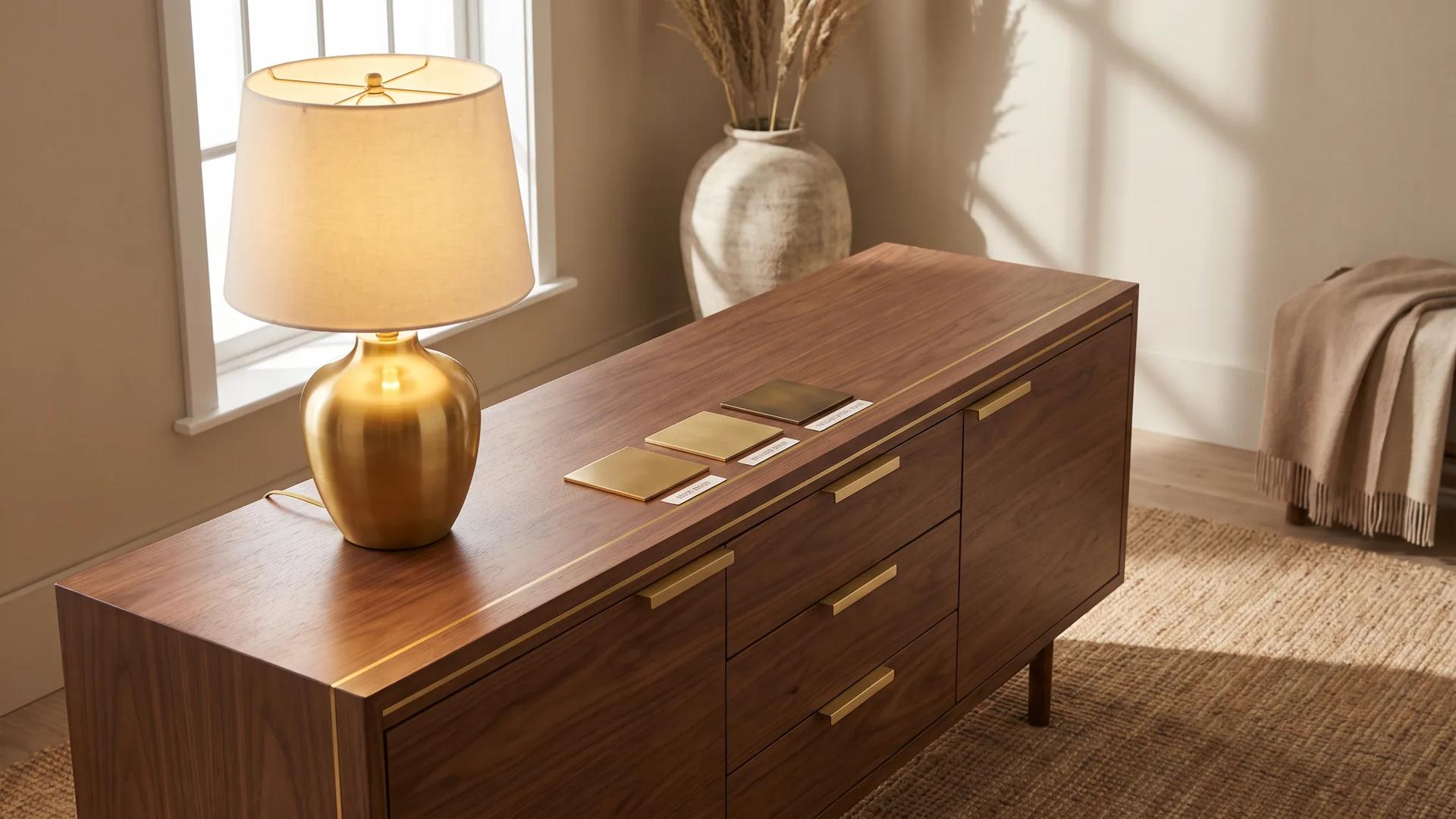
We use brass in four main places in our production: leg construction (tables, coffee tables, consoles, sideboards), handle and hinge detail, shelf edge profile, and decorative frames. Our clients mostly prefer brass service carts, brass bookcases and brass-legged dining tables. For surfaces requiring lasting shine, oxidation resistance, and longevity, we use 4 mm thick PVD-coated brass.
Frequently Asked Questions
What is brass made from?
Brass is not found in pure form in nature. It is an alloy produced from copper (60-70%) and zinc (30-40%). Copper and zinc ores extracted from mining are melted and mixed to create brass. Higher zinc content makes brass more yellow, while higher copper content gives it a reddish tone.
Is brass gold?
No, brass is not gold. Though visually similar, brass is a copper-zinc alloy. Gold is a pure element (Au, atomic number 79), while brass is a mixture of two different metals. Because its color is close to gold, brass is known as "poor man's gold" in decoration, yet costs roughly 500 times less than gold.
What is a brass mine?
"Brass mine" is technically incorrect because brass does not occur naturally in mines. In everyday language, "brass mine" usually refers to the copper and zinc mines that produce brass. The world's largest copper reserves are in Chile, Peru, the USA, and Congo. Zinc is concentrated in China, Peru, Australia, and India. In Turkey, copper mining operates in Kastamonu Küre, Artvin Murgul, and Elazığ Maden Köprübaşı.
Does brass tarnish?
Unprotected raw brass oxidizes over time with air contact, forming a dark patina. Some users prefer this antique look. Modern furniture prevents this with lacquer or PVD coating. PVD-coated brass retains its shine for 10+ years and requires no polishing.
What is the difference between brass and bronze?
Both are copper-based alloys but with different compositions. Brass: copper + zinc (yellow-gold tone). Bronze: copper + tin (reddish-brown tone). Bronze is harder and more wear-resistant than brass, preferred for sculpture and ship parts. Brass is easier to work with and aesthetically brighter, making it more common in furniture details.
How long does brass furniture keep its shine?
Without protection, brass begins to darken within 6-12 months. Lacquer protection lasts 2-3 years, then needs renewal. PVD-coated brass retains its first-day shine for approximately 10+ years and does not oxidize even in humid environments like kitchens and bathrooms. We use only PVD-coated brass in Archidecors production, which is why our products require no polishing for 10+ years.