
Design Inspiration
July 21, 202415 min
Interior Design Movements 2026: Minimalism, Japandi and 8 Other Styles
From Classic to Minimalism, Art Deco to Japandi, a comprehensive guide to the most influential interior design movements worldwide.
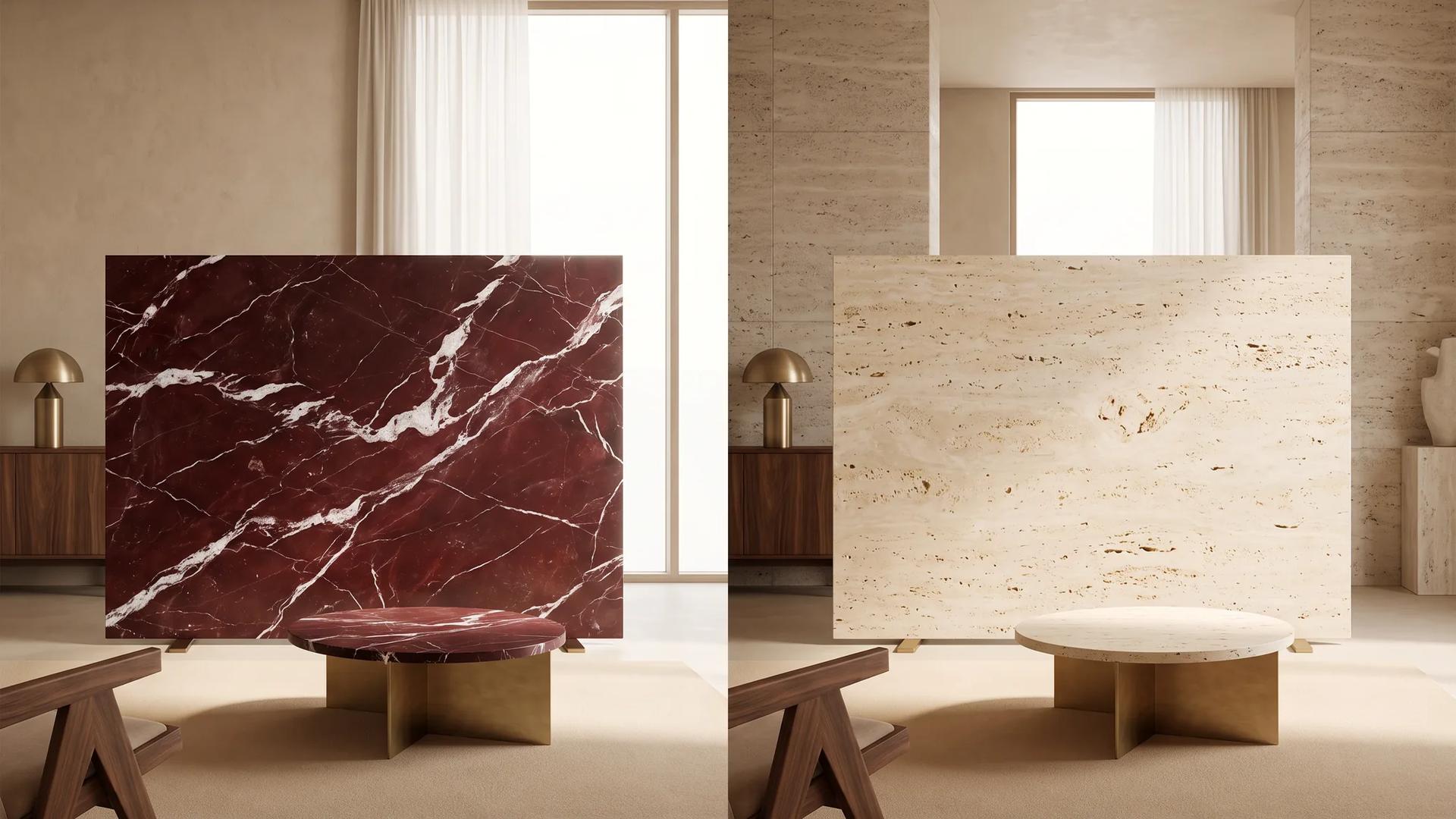
A villa brief came in last month, from the Beykoz side of Istanbul. Husband and wife in their thirties, building their new home. The opening was clear: "We want marble, but we're tired of Calacatta. Show us something else." The slab I brought to the showroom was Elazığ Cherry. They talked for thirty minutes, picked up the slab, said "this". Same week another client decided on travertine for a Çeşme villa. Two months earlier both would have asked, "is there marble other than Calacatta?" Now they don't ask; their eyes drift toward a different stone.
The reason I'm writing isn't them. The reason is this: in 2026 a stone has shifted in the interior design conversation. The crown white marble has worn for years is starting to spread across other colors and textures. Turkey's advantage is that the two new stars also come from our own soil, Elazığ Cherry and Denizli Travertine. One has a vein the color of blood, the other has a porous limestone memory on its surface. Both have existed for years, but in 2026 they entered an entirely new conversation.
Stack the past decade's interior magazines together and the cover keeps showing the same stone: Calacatta. White ground, gray vein, mined out of Italy's Carrara village. From 2010 to 2024 it was the silent monarch of design language. The kitchen island, Calacatta. The living-room coffee table, Calacatta. The bathroom counter, Calacatta. When a design language repeats too long, it tires. By 2025 the fatigue had become visible.
In 2026, Porcelanosa wrote about travertine as "the most seductive trend". Pantone's Cloud Dancer is a soft white, but the only material it calls to its side isn't polished stone; it's raw porosity, warm texture, lime whiteness. Salone del Mobile's Fòco installation builds on fire and embers (Erhan covered Milan in detail). Flip through the trend pages of Designboom, Dezeen, Architectural Digest and the same pattern repeats: dark vein, warm skin, natural imperfection. White marble is still there, but no longer alone.
The contradiction isn't accidental. Client psychology grew out of it: post-pandemic home life deepened, and the search shifted from "photogenic space" to "real touched surface". Marble shines but stays cold; travertine is raw, but feels alive when touched. Cherry too, in a different way, a dark ground keeps the eye busy, doesn't collect light at one point. Both stones point to two different kinds of calm.
Elazığ Cherry (international name: Elazığ Cherry Marble) comes straight from eastern Turkey. Elazığ province, around Lake Hazar. Color palette: deep burgundy ground, white or light-gray vein, a hint of honey-coated cherry tone here and there. The name isn't poetic; the first thing anyone facing the surface says is "cherry jam poured from a jar". From the quarry it travels as a prestigious building stone in European, Gulf, and Far East markets. A lobby in Dubai, a bathroom floor in New York, a stair facing in Beijing, Turkish Cherry sits there quietly.
Why do I love this stone in production? Three reasons. One, it's a stone you can hide things on. White marble shows every water drop, every coffee ring like a stain a week later. Cherry doesn't fight the water drop the same way. Two, the vein distribution differs in every slab; even if two clients want the same design, the marble itself produces two distinct pieces. Three, the burgundy skin opens a warm lyric next to Italian walnut, it lands at the center of a cool-lit room.
Where does it work? Living room coffee table, a classic on top of another classic. Dining table, eight-seat rectangle, on a wood or brass base. Entry hall console, beside the key tray. As an accent panel behind a headboard; I proposed exactly that on the Beykoz brief last month. As a full bathroom suite? If the client doesn't love drama, no; if they do, there's a chance to draw a single piece from washbasin counter to floor.
Where does it strain? Very small areas. Cherry's power lives in volume; a three-square-meter bathroom won't carry the weight under the lighting. For an apartment's small kitchen island it can also feel too heavy, the slab's vein weighs the whole space alone. Burdur Beige or Afyon White are lighter alternatives there.
Denizli Travertine is a different story. Same geography, limestone layers millions of years old beneath Pamukkale's white terraces. Surface porous, curled, lime carved into the texture. Color scale: cream-beige-honey somewhere in between, sometimes veined sometimes plain. Considered "the world's benchmark" globally (the materials guide covers the technical side); exported to six continents. European hotels fight over it for lobby flooring, American villas for facade cladding.
The craft side of travertine differs from marble. Pores are natural; if you don't fill them and leave them as is, the surface adds a raw feel; if you fill and polish, it reaches the same smoothness as marble but the texture still speaks under light. We do both in production; villa clients say "keep it rustic", hotel projects ask for "sealed surface, no staining". Both choices are legitimate, expectation just needs to be clear. For our Seba project in Gölköy, Bodrum, we made an oval travertine dining table and block travertine coffee tables.
Travertine's 2026 rise comes from sustainability and biophilic design narratives. Materials that don't hide their imperfection are gaining value again. Fabricated marble fakery loses anyone who can tell; real raw stone, with its small cavities and color variations, gives the "anyone passing through this house notices" feeling. Mediterranean style is in fashion again, the Greek island home dream, Spanish countryside, warm beige walls. Travertine sits at the center of that atmosphere.
Where does it work? Kitchen island countertop, with white wood cabinetry. Bathroom floor + shower wall. Coffee table, a warm center in front of the seating. Console, the start of earth tones in the foyer. Outdoor terrace, this matters, travertine handles outdoor use. Calacatta won't survive a Turkish summer; travertine does.
Both Turkish stones can sit in the same home, in fact this is a combination I recommend. Living room coffee table in cherry, kitchen island in travertine, one dramatic, the other calm. But if a choice has to be made, look through this frame:
Cherry suits you if: You like dark furniture, dramatic lighting, contrast. The space is open, light is sufficient, no clutter. You want a lyrical accent, the slab speaks at the center of the room. Use cases: dining room, waiting area, headboard panel, central living-room coffee table. Contrast partner: walnut or patinated brass.
Travertine suits you if: You're after warm, organic, Mediterranean atmosphere. White furniture, light wood, light textures sit in your language. You tolerate natural imperfection (porous surface increases stain capacity slightly). Use cases: kitchen island, bathroom, outdoor, in front of the seating. Contrast partner: oak, linen, raw cotton.
Both suit you if: Open-plan home. Living room with wood floor + travertine coffee table, dining room with cherry table + cream walls. Two stones represent the two ends of the same palette; they create a rhythm inside the home. One of my favorite briefs in production is exactly this, the client who says "I don't want a single stone, I want my home to tell a story".
There's a third option: the rest of the Turkish palette. Afyon White rivals Italian Carrara in purity, Muğla White is the contemporary architect's favorite, Burdur Beige is the choice for those after a soft beige. We work all four in production; the brief's tone picks the marble, not the other way around.
"Marble table" is a key word for the upper class in the Turkish home market. Last month while having tea in Şişli with an interior designer friend, the topic came up. "Half the clients arrive saying Calacatta dining table; a third leaves with cherry, the rest with travertine." Supply has changed, demand is changing. The Turkish home has shown wealth through a marble table since the late Ottoman era; neither a 1960 Sirkeci mansion nor a 2026 Beykoz villa happens without it. Form changed, material stayed roughly the same.
The dining table is a dramatic piece. An 8-12 seat marble rectangle defines the center of the living space. Height 75 cm, top thickness 20 mm polished + filled underneath, base in solid wood (walnut, oak) or 4 mm PVD brass. A cherry slab's weight on a 10-seat table runs 180-220 kg, travertine 160-200 kg. Base design is engineered to carry that load; otherwise the bottom warps and the top slides.
The living-room coffee table is lighter, more playful. An 80 cm round version of the cherry slab weighs 30-40 kg, leg freedom comes from there. The most common round coffee table form in our production: 90 cm diameter, 4 cm polished cherry top, 50 cm height, wood pedestal. Made in travertine, the texture difference is immediate; one says "let's burn", the other says "sit, sip your tea". Both are legitimate moments.
Three marble dining table models stand strong in our catalog; all three can be cut in Turkish marbles on request. Tombo Marble Table sits in the catalog with a Calacatta top, the same form is shaped in Elazığ Cherry the moment a client asks. Vogue Ellipse Table draws a dramatic ellipse line in Volakas marble; on a travertine request, the same curve repeats over a Denizli slab. Rome Dining Table holds the classic Carrara template; if the client wants Afyon White or Muğla White, the same elegance pulls through from those quarries. None of the three is a fixed list; every brief can shift to cherry, travertine, Calacatta, or beige tones. Pick the model, pick the stone, let us tailor the dimensions to 1 mm precision in production. If you're after a marble coffee table, the coffee table collection carries round and rectangular options under the same craft discipline.
The slab arrives raw from Elazığ or Denizli. Three steps follow in production. Step one is cutting, CNC machine cuts the slab to plan, accuracy 1 mm. Step two is surface treatment, polished, brushed, antiqued (semi-matte). Cherry usually wants full polish; lacking porosity, polish makes it shine. To keep travertine's pores hidden you go fill + polish; to keep them open you stop at brushing. Step three is edge finishing, beveled, chamfered, profiled. When the client wants a tableaux feel we use a 5-10 mm chamfer; for modern crispness, a flat 90-degree edge.
The most commonly mishandled task in marble furniture is sealing. Natural stone is porous, microscopic in cherry, visible in travertine. Professional sealing is needed once a year, otherwise stains penetrate. Our production sends a sealing service reminder every two years to every client; this isn't a "after the invoice it's forgotten" job, it's an ongoing relationship.
Then there's slab transport. Rolling a 220 kg dining table top up to a Beykoz address is its own engineering. We do custom pallets in production, and door dimension is the brief's first item: "Is the elevator opening 90 cm? Is the stair turn 100 cm?" The client waits at home, the slab can't enter the home, the whole month goes to waste. We learned this on many projects; the door drama on the Florya renovation is a long memory.
Natural stone is beautiful, but it asks for two things: sealing and patience. Daily cleaning is simple, pH-neutral detergent + microfiber cloth. Acid is the natural enemy: lemon, vinegar, tomato juice, wine. If they touch the surface, wipe them off immediately; sealing offers 30-60 seconds of protection, no longer. Annual professional sealing is a low-cost maintenance item, and a package covering table, coffee table and bathroom together is more economical in one go.
Let's clear the budget side. A custom-made cherry dining table sits in the upper segment, with dimensions and base construction setting the price. A travertine table the same size is generally a touch more accessible, varying by the pore-fill choice. A living-room coffee table in either stone carries a lighter budget. Kitchen island countertops are calculated by the square meter regardless of stone type; a single-slab wide island naturally lands in the upper band. For current and exact pricing on your project, send a brief and we return a quote within 24 hours.
Cheaper alternatives exist: quartz composites (Caesarstone, Silestone), large-format porcelain slabs (Laminam, Neolith), ceramic slab imitations. All have a "marble-look" but they aren't natural stone. If the client says "no staining, no maintenance", quartz is a rational choice. If they say "let the home be real, let the stone be alive", no composite replaces natural marble. Erhan covered the technical side at length in the marble vs quartz comparison; if you're going to talk budget, read that piece first.
Is Elazığ Cherry really Turkish marble or imported?
Entirely Turkish. It comes from quarries around Lake Hazar in Elazığ province. In Turkey's natural-stone export records it appears as "Elazig Cherry" or "Burgundy Marble Turkey". Across European, Gulf, and Far East markets it's a prestigious stone, in the premium price segment competing with Calacatta. Our production facility sources slabs directly from Elazığ quarries, no intermediary.
Why is Denizli Travertine so popular?
Three reasons. One, it's considered "the world's benchmark" globally; the volume and quality sit in Turkey. Two, the 2026 trend's pursuit of raw texture + organic imperfection has lifted travertine into the center of the conversation (Porcelanosa called it "the most seductive trend"). Three, it works outdoors, Calacatta won't survive Mediterranean garden and pool environments, travertine does.
Can cherry and travertine be used together?
Yes, in fact this is one of the recommended combinations. The only condition is the rest of the palette stays calm, white walls, light wood floors, cream linen fabrics. The contrast between the two stones is warm but distinct; cherry is dramatic, travertine is natural. Living room coffee table in cherry + kitchen island in travertine has been applied in four projects in our production over the past six months.
How heavy is a marble dining table top, are there transport issues?
A 10-seat rectangular cherry table top weighs 180-220 kg, travertine 160-200 kg. With base construction added, total is 230-280 kg. For apartments, door + elevator + stair-turn dimensions are among the first three things asked at brief intake; most clients say "our door is 90 cm" but the elbow turn not included in the frame measures 75 cm. Our production facility does pre-project door surveys; sadly there's no option to carry the slab back later.
Can hot pots be placed on a marble table?
No, on no natural stone. Calacatta, cherry, travertine, doesn't matter. Sudden temperature change creates thermal shock, micro-cracks. After 2-3 years the crack grows, the slab is replaced. Always use a trivet, wooden cutting board, cork mat, silicone underlay. The same applies to a refrigerated tray; very cold metal also causes thermal shock.
Where are Turkey's best marble quarries?
Five main basins. Elazığ (Cherry), Denizli (Travertine + Beige), Afyon (White + Sugar), Muğla (White), Burdur (Beige). Each has its own character and color scale. Elazığ + Denizli are leaders in export, Afyon + Muğla dominate in the domestic market, Burdur runs heavy on the seasonal Mediterranean villa scene. Our production facility works with all five basins; the brief's tone tells us which quarry to start with.
How long does a marble table last?
50+ years with proper care. We still service marble tables made 30 years ago at our Modoko production; pieces passed from generation to generation. But "proper care" is the underlined phrase: yearly sealing, acid contact management, heat insulation. If neglected, the surface looks dead in 5 years, stains, restoration becomes hard. With a simple check every six months the marble becomes the home's longest-lived piece of furniture.
Turkish marbles found their own stage in 2026. Beside the crown Calacatta has worn for years, Elazığ Cherry and Denizli Travertine placed two new stories; both stones pass through the bench of our Modoko production. To discuss a marble table brief, reach the contact page, or send your brief through the custom furniture page. The dining tables category has existing models, but the real story begins with your brief. When you pick up the slab in our production, let's listen together to what the stone is telling you.
From Classic to Minimalism, Art Deco to Japandi, a comprehensive guide to the most influential interior design movements worldwide.
What changed in 2026 furniture trends? Warm minimalism, Japandi, organic forms and the natural materials revolution, expert analysis.
Browse our crafted furniture collection, each piece designed with the same principles discussed in this article.
Design inspiration, new collections and expert guides, directly to your inbox.
Our team of expert designers and craftsmen are ready to bring your vision to life.
Get a quote for your project
Get Quote